Railroad Tie Retaining Wall
Old railroad tie retaining walls in Charlotte yards: why they lean, what the EPA says about creosote ties, and what a block wall replacing one needs.
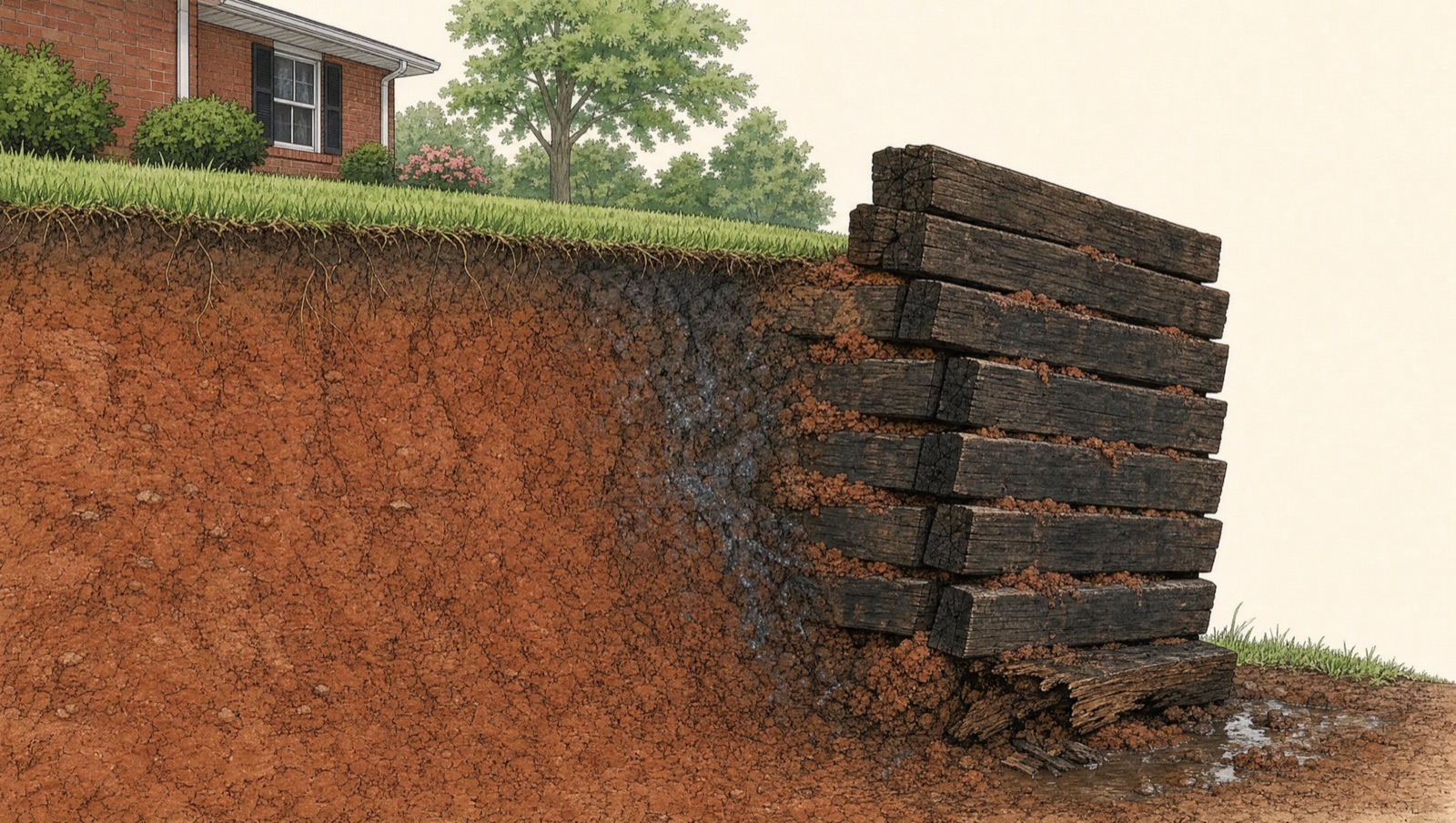
A railroad tie retaining wall is a stack of used creosote-treated crossties holding back soil, and when one gives out in a Charlotte-area yard, the signs to look for are leaning, bulging at the bottom course or spilling red clay through its joints. The ties were never designed as wall units. Used ties sold for landscaping come from track the railroads have pulled, and when a tie wall fails, the fix is not another row of ties. It is a wall with a real base, drainage behind it and reinforcement where the load needs it.
Outdoor Custom Hardscapes builds retaining walls across Charlotte, Huntersville, Cornelius, Davidson, Mooresville, Denver and Concord in segmental block, natural fieldstone, boulders and stone veneer over block. This guide covers why tie walls behave the way they do, what the EPA actually says about creosote ties in a yard, and what changes in the ground when one is replaced.
Key takeaways
- About 23 million new wood crossties go into North American track each year, mostly replacing worn ties, according to a survey of 2017 railroad practices published in 2019. Reuse for landscaping is a common outlet for the ties that come out.
- The EPA says reuse of creosote ties as landscaping timbers is not subject to regulation by EPA under pesticide laws. It did not find health risks of concern for the general public.
- Do not burn old ties. The EPA says not to burn creosote-treated wood in a residential setting.
- The EPA says disposal can usually go through ordinary trash collection, and to check with your state or local waste management program for specific guidance.
- A replacement block wall needs more ground than the tie wall used: a buried base, a drain stone zone behind the block and, where required, geogrid dug back into the slope.
Where the ties in your yard came from
Crossties are wood timbers, and about 95% of the ties railroads buy are preservative-treated wood. The 2018 Railroad Tie Survey, conducted by the Association of American Railroads and published in the Journal of Transportation Technologies in 2019, describes the supply side plainly. North American railroads buy about 23 million new wood crossties a year, and most of them go in to replace old ones. The ties that come out wear out through normal decay, insect attack, and physical impact and abrasion, among other causes.
Those removed ties have to go somewhere. For 2017, the survey reports about 66% recycled for energy and about 6% sent to landfill, and it describes reuse for landscape and agricultural purposes as common. It also notes that better-quality removed ties are sorted out for landscape and agricultural uses, and those ties may be sold to middlemen or retail building supply companies.
Read that sequence once and a tie wall makes more sense. If the timber holding up your slope is a used crosstie, it came out of track that was being renewed, and the survey lists decay and insect attack among the reasons ties are pulled.
Why a tie wall leans in Piedmont clay
A tie wall and an engineered wall fail for some of the same reasons, but the tie wall starts with three built-in disadvantages.
The material decays where it matters most. Wood in contact with damp soil is exactly what preservative treatment is meant to slow, not stop. In a stacked wall, the bottom tie sits at the lowest point of the slope and carries the weight of every tie above it. When that one softens, the whole face tips.
Water may have nowhere to go. A wall of ties laid straight against backfilled clay has no drain stone behind it and no pipe at its base. Water in the slope pushes against the back of the wall, finds the joints between ties, and brings soil out with it. Allan Block's own residential guide says the design and performance of most retaining walls are based on keeping the area behind the wall relatively dry, which is the one thing a tie wall built this way cannot do.
The base is whatever was there. A tie wall set directly on grade, or on a shallow scrape in the lawn, has nothing compacted and nothing buried beneath it. If the first course was not level, every tie above it inherits the error.
Charlotte's red clay adds its own pressure. Allan Block's guide notes that clay soils retain moisture, which adds pressure behind a wall, so a tie wall with no drainage behind it takes that pressure directly.
The creosote question, answered from the source
Search for railroad ties and creosote and you will find two confident camps: one says the ties are toxic and must never touch a garden, the other says they are harmless. The U.S. Environmental Protection Agency's creosote page is more specific than either.
Creosote-treated railroad ties are sometimes recycled as landscaping timbers.
U.S. Environmental Protection Agency, Creosote
On the same page, the EPA says creosote poses cancer and non-cancer health risks of concern to workers in wood treatment facilities, and that it did not find health risks of concern for the general public, or for workers who handle creosote-treated wood after it has been treated. It says creosote products are not available to homeowners, and that reusing creosote-treated wood as landscaping timbers is not subject to EPA regulation under pesticide laws. It also notes creosote may pose risks to fish and invertebrates where treated wood is used in aquatic and railroad structures.
The Agency for Toxic Substances and Disease Registry adds context in its ToxFAQs for creosote: skin and eyes can become irritated by exposure to creosote compounds, and among its protective steps it suggests teaching children how to identify creosote-treated wood. The same ATSDR page notes that the EPA classifies creosote as probably carcinogenic to humans. The EPA's separate finding, quoted above, is that it did not find health risks of concern for the general public. Taken together, the two pages are a sensible reason to wear gloves and long sleeves when a wall comes apart, and a reason not to leave loose ties where children play.
Where the EPA is unambiguous is burning. Its guidance is not to burn creosote or other preservative-treated wood in a residential setting, because of the toxic chemicals in the smoke and ash. Old ties do not go in the fire pit.
Getting the old ties out of the yard
The EPA says homeowners can usually dispose of creosote-treated wood through ordinary trash collection, as municipal solid waste. It then says, twice, that state and local governments may have specific guidance, and to check with your state or local waste management program. That is the whole of the federal answer, and it is the right place to start in Mecklenburg, Iredell, Lincoln or Cabarrus County: call the county or town program before the wall comes down and ask how, and how much, they will accept.
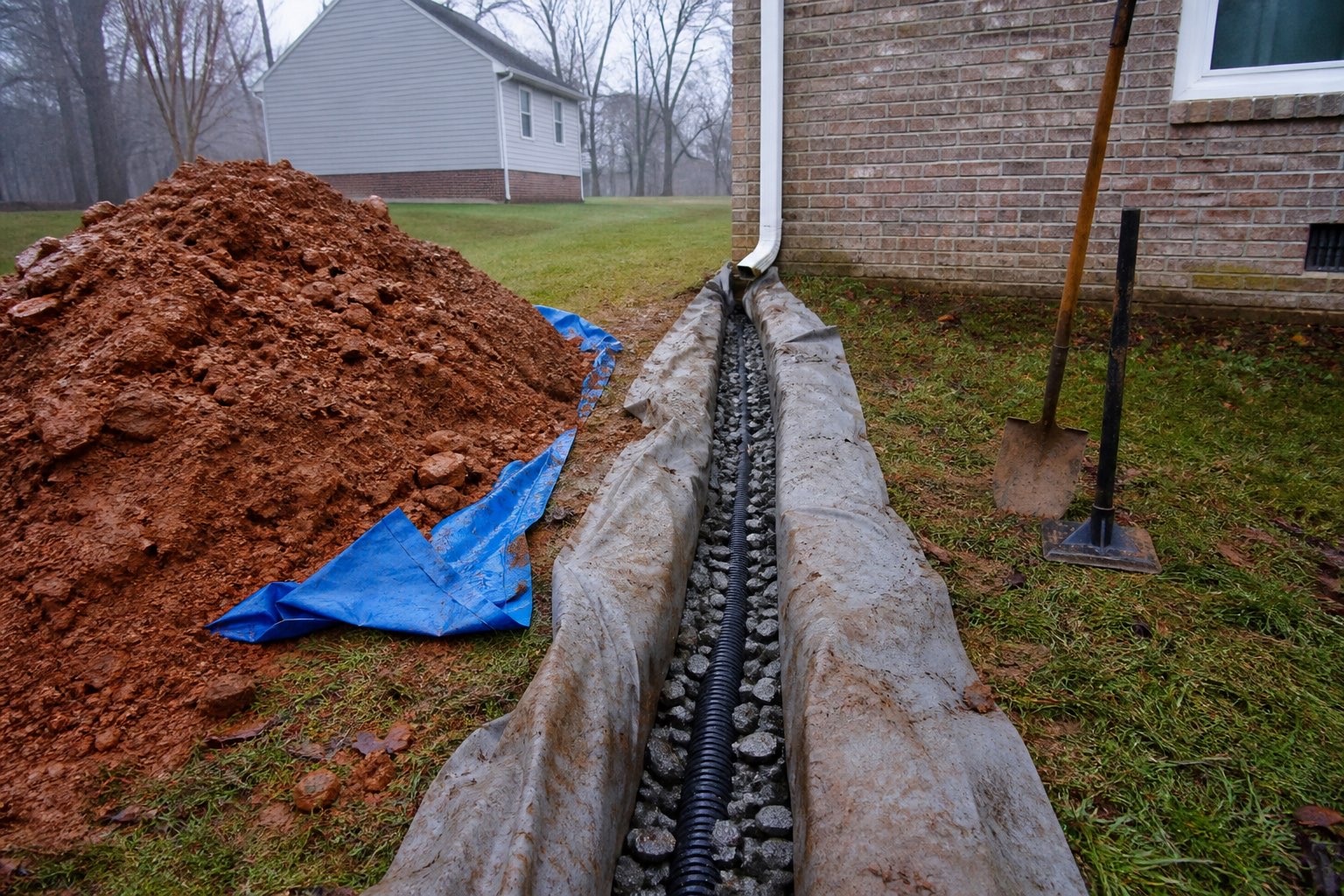
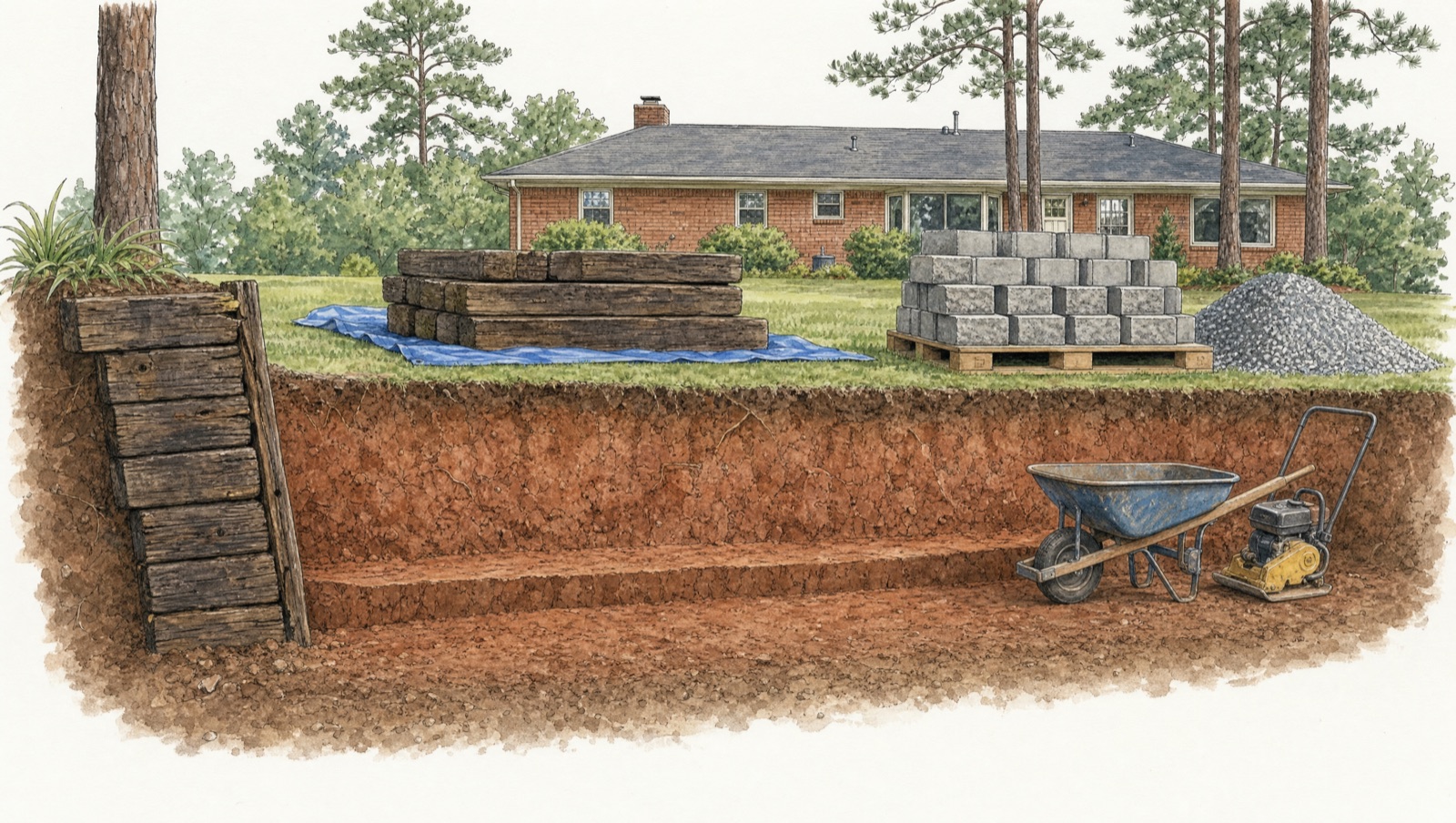
Plan for the volume. A wall that is several ties high and runs the length of a backyard is a large pile of heavy, awkward timber, and it has to be staged somewhere on the property while the new wall is built. The illustration above is the realistic picture: ties on a tarp, the clay bank exposed, the new base trench dug along the old line.
What the replacement wall needs that the tie wall never had
A block wall on the same footprint disturbs more of the yard than the tie wall ever did, because much of what makes it work is below grade and behind the face.
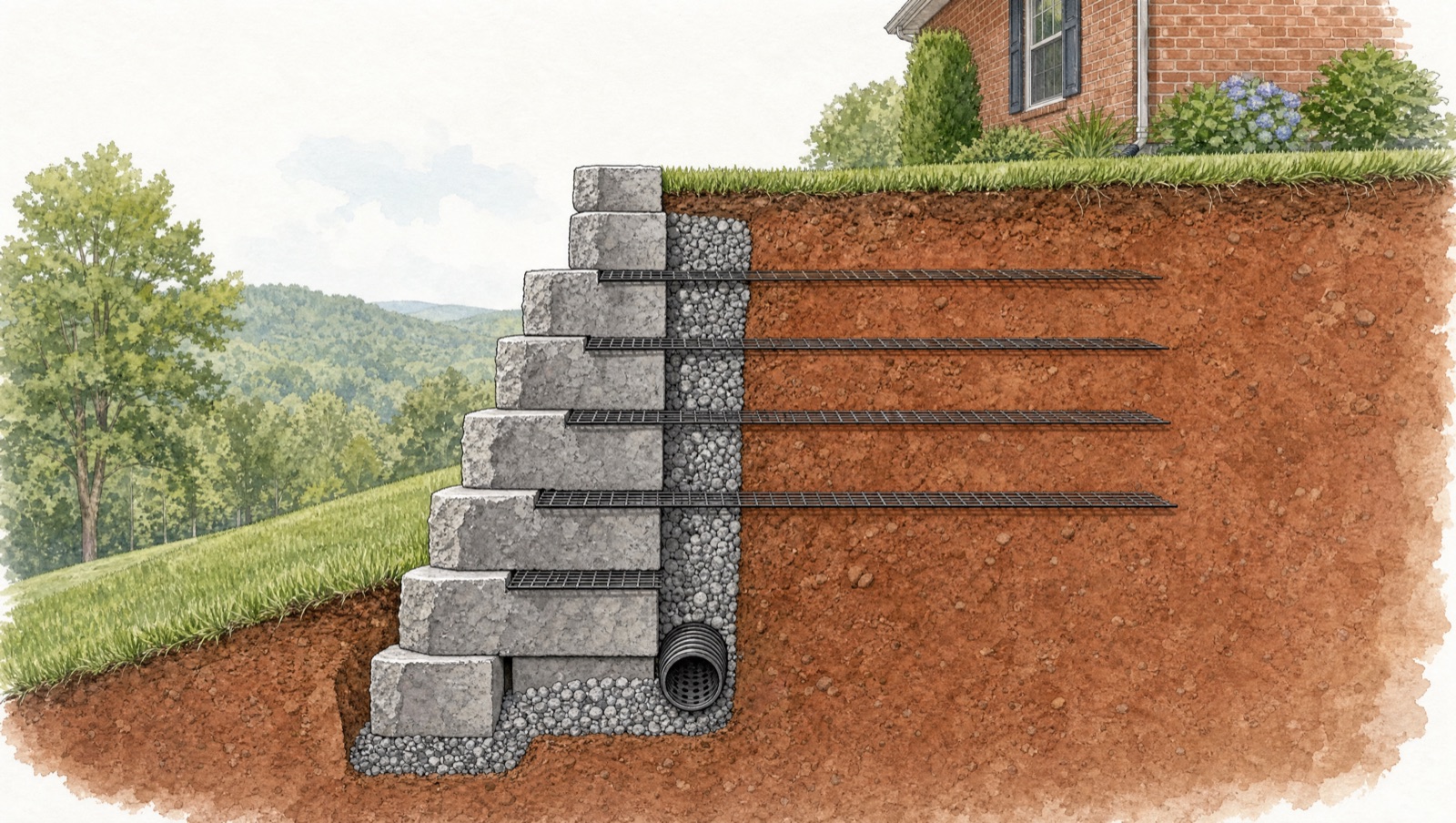
Outdoor Custom Hardscapes builds structural walls with engineered segmental units, Allan Block and Versa-Lok, and its retaining wall service page lists drain stone, filter fabric and perforated pipe behind every wall, with geogrid, base depth and batter specified to what each wall has to hold. Allan Block's residential retaining wall guide, written for walls under 6 feet, puts numbers on those parts.
| Part of the wall | Block wall specification | What to look for on the old tie wall |
|---|---|---|
| Base trench width | 24 in (18 in for walls under 4 ft) | Was there a trench at all, or were ties laid on grass? |
| Base trench depth | 6 in, plus 1 in of buried block per 1 ft of wall height (4 in plus buried block for walls under 4 ft) | Is the bottom tie on the surface, or buried? |
| Base material | At least 6 in of compacted wall rock, two passes with a plate compactor | Soil, or stone? |
| Drainage zone | Wall rock in the block cores and at least 12 in behind the block | Clay packed directly against the back of the ties |
| Wall rock size | Ideally 0.25 in to 1.5 in aggregate with no sand, silt or clay | Fines washing out through the joints |
| Drain pipe | Required for reinforced walls, gravity walls over 4 ft or poor drainage sites, vented to daylight every 50 ft | Wet soil or seepage at the foot of the wall |
| Backfill lifts | 8 in or less, compacted | Settling or cracks in the ground above the wall |
The digging behind the wall
Here is an operational detail that changes the homeowner's plan. When a wall needs geogrid, the grid does not stop at the block. Each layer is laid on a block course from the front lip of the block back toward the back of the excavation, and Allan Block's guide says the excavation behind the wall has to accommodate the design length of that geogrid. The soil behind a tie wall, whether that is a lawn, a planting bed or the edge of a patio, gets dug out, the grid goes in, and the fill is placed back and compacted in lifts.
The base trench works the same way. The guide says foundation soils at the bottom of the trench must be firm and solid, and that heavy clay, wet soils or previously excavated ground should be removed and replaced with granular material compacted in lifts of 8 inches or less. Ground that sat under a failing, wet tie wall for years is a likely candidate. That is why an itemized estimate for a tie wall replacement should show demolition, disposal, base excavation, base replacement and backfill as separate lines, not one number for "new wall."
Whether a given wall needs grid, and how much, is an engineering call based on height, soil and what sits above it. Outdoor Custom Hardscapes handles permits and engineered drawings for taller walls. The Mecklenburg County retaining wall permit guide covers when a permit applies, and it is worth reading before you assume a replacement is exempt because the ties may never have had one.
Reading your own tie wall before you call anyone
A few minutes with the wall tells you how urgent this is.
Push a screwdriver into the bottom tie. If it sinks in easily, the timber carrying the whole wall is soft.
Sight along the top. A wall that has rolled forward in the middle is moving, not settling.
Look at the joints after rain. Red clay or muddy water weeping through means water is pushing soil through the face.
Check what sits above. A driveway, a patio, a shed or a pool on the high side adds load a tie wall was never designed to carry.
Check the ground at the top. A crack in the ground running parallel to the wall can mean the soil mass is moving with it.
If more than one of those is true, stop adding soil or weight above the wall and get it looked at. Outdoor Custom Hardscapes gives free, on-site, line-itemed estimates for retaining walls in Charlotte and the Lake Norman towns. Start from the Charlotte service area page or call (980) 292-3663. If water is a larger problem on the lot than the wall alone, the drainage service can be part of the same job.
Frequently asked questions
Are railroad ties safe to use for a retaining wall?
The EPA's position is narrower than either side of the argument. It says creosote poses health risks of concern to workers in wood treatment plants, and that it did not find health risks of concern for the general public or for workers who handle creosote-treated wood after it is applied. It also says reusing old creosote ties as landscaping timbers is not subject to regulation by EPA under pesticide laws. That is not the same as a recommendation, and the EPA lists alternatives to creosote-treated wood. Outdoor Custom Hardscapes builds retaining walls in segmental block, natural fieldstone, boulders and stone veneer over block.
How long does a railroad tie retaining wall last?
There is no reliable published lifespan for a landscape wall built from used railroad ties, and any single number you are quoted is a guess. What is documented is that railroads pull ties out of track for reasons that include decay, insect attack and physical wear, and that the landscape market is supplied from those removed ties. How long a used tie lasts in a wall depends on the tie, the soil and whether water can drain out from behind the wall.
Can I burn old railroad ties from a retaining wall?
No. The EPA says not to burn creosote or other preservative-treated wood in a residential setting, because the smoke and ash can carry toxic chemicals. That rules out a fire pit, a burn pile and a wood stove.
How do I get rid of railroad ties in Charlotte?
The EPA says homeowners can usually dispose of creosote-treated wood through ordinary trash collection as municipal solid waste, and also says state and local governments may have specific guidance or instructions for disposing of treated wood. Before a wall comes down, check with your county or town solid waste program on how many ties they will take and where, because a full wall is a lot of heavy timber and pickup limits are worth asking about in advance.
Can a new block wall go where the tie wall was?
It can go on the same line, but not on the same ground. A segmental block wall needs a compacted gravel base in a trench, its first course set below grade, a column of drain stone behind the block and, where the load calls for it, geogrid reinforcement laid back into the soil. Allan Block's residential guide also says heavy clay or wet soils at the bottom of the base trench should be dug out and replaced with compacted granular material, so soil that sat under a failing tie wall for years can be part of what comes out.
Do I need a permit to replace a railroad tie retaining wall?
It depends on the height of soil the new wall retains, whether anything like a driveway, pool or structure sits above it, and your jurisdiction. Do not assume a replacement is exempt because the old tie wall may never have had a permit; check before the new wall is designed. Outdoor Custom Hardscapes handles permits and engineered drawings for taller walls, and the Mecklenburg County permit guide on this blog covers when one applies.
Should I rebuild the wall with new pressure-treated timbers instead?
You can, but it resets the same clock rather than stopping it. Any timber wall holds soil with a material that decays in ground contact, and decay is one of the reasons railroads pull ties from track. If the wall is retaining real soil, a segmental block or stone wall built on a proper base with drainage behind it is the version that does not have to be replaced again for the same reason.