Dry Creek Bed
A dry creek bed moves storm runoff across a Charlotte clay yard to a safe outlet. Where it works, where a French drain fits better, and how one is built.
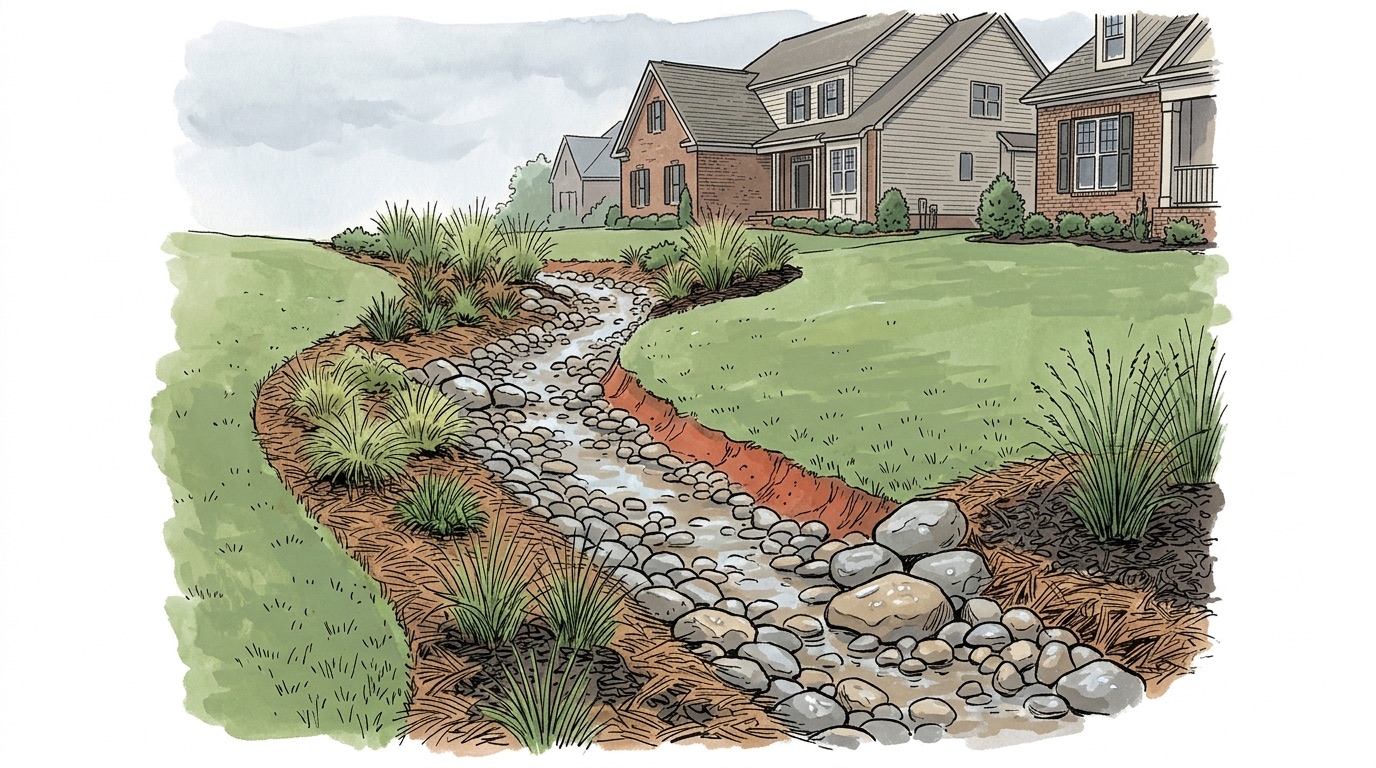
A dry creek bed is a shallow channel lined with river rock and cobble that carries storm runoff across a yard to a safe outlet and sits dry between rains. On a Charlotte-area clay lot it is the right fix when the problem is water running over the surface and cutting a path, and the wrong one when water is soaking the ground or has no lower place to go.
Outdoor Custom Hardscapes is a hardscape and drainage contractor serving Charlotte, Huntersville, Cornelius, Davidson, Mooresville, Denver, Concord and the Lake Norman towns. Its drainage service covers French drains, buried downspouts, channel drains, catch basins, dry wells, regrading and swales, and erosion control. A dry creek bed is a swale with a stone lining, so it belongs with regrading and swales. This guide covers where one fits, where it does not, and how it is built so it survives the first real storm.
Key takeaways
- A dry creek bed moves surface runoff. It does not pull water out of saturated ground; that is the job of a French drain.
- It has to carry the storm it will actually get. NOAA Atlas 14 puts the 10-year, 24-hour rainfall at Charlotte Douglas International Airport at 4.86 inches, retrieved September 23, 2026.
- Stone is a lining chosen for water speed, not only for looks. North Carolina's CCAP swale manual lists a maximum permissible velocity of 4 ft/s for grass and 6.5 ft/s for riprap.
- Fabric under the stone is a separator. NRCS calls for geotextile, where appropriate, to keep soil particles from migrating from the subgrade through the lining.
- The outlet decides whether the whole thing works. NRCS requires a stable outlet for any lined waterway, and discharge toward a public right-of-way or stream can need a permit.
A dry creek bed is a swale with a stone lining
Strip away the landscaping language and a dry creek bed is a small lined waterway. The USDA Natural Resources Conservation Service defines one in its Conservation Practice Standard 468, Lined Waterway or Outlet (September 2020) as a waterway or protected outlet section with an erosion-resistant lining of concrete, stone, synthetic turf reinforcement fabrics or another permanent material. Among the purposes it lists are carrying runoff from flow concentrations without causing erosion or flooding, and stabilizing existing gully erosion. A backyard creek bed is the stone version at residential scale.
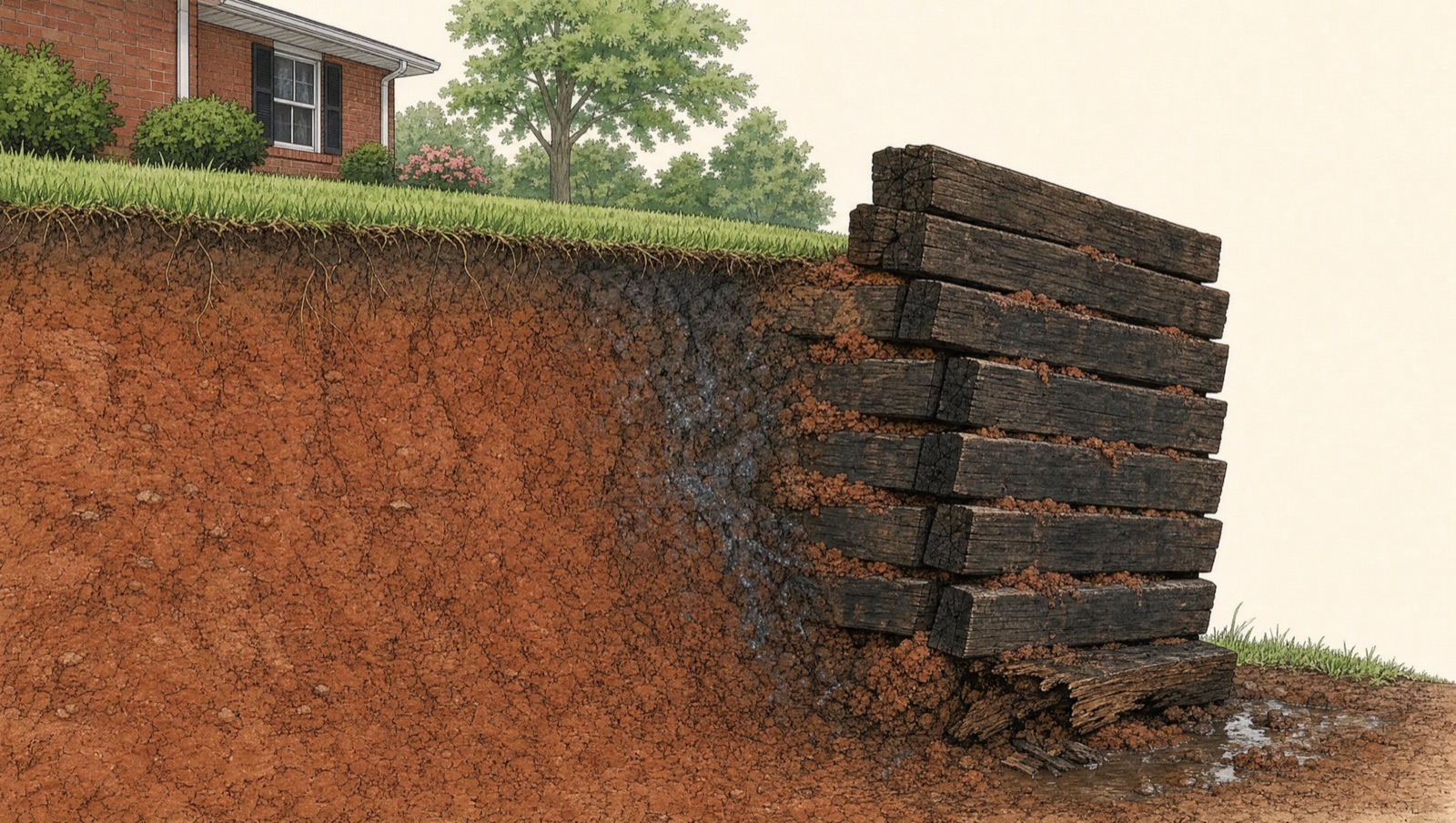
North Carolina has a good homegrown example. The NC State Extension Gardener Plant Toolbox documents a dry rock stream garden in Davidson County, established in 1993, on a house set on the side of a steep hill. Rainwater flowed toward the house, had nowhere to go, and was eroding the soil into a ditch. Several tons of rock were placed along the eroded ditch, and plants were added around them to soften the stone and help hold the surrounding soil. The toolbox entry says the erosion problem was solved.
That is the pattern worth recognizing in your own yard. The water was already choosing a path. The creek bed did not invent a new one; it armored the one the water had picked so the next storm could not keep cutting it deeper.
What stone can and cannot do on Piedmont clay
The French drain cost guide walks through the USDA description of the Cecil series, one of the Piedmont soils around Charlotte: a thin sandy loam surface over firm, sticky red clay. That profile matters here for one reason. When water cannot get into the ground quickly, more of each storm moves across the surface, and surface water that concentrates in one line is exactly what a lined channel is built to handle.
What a creek bed will not do is dry out a lawn that stays soft for days with no visible flow. That water is already in the soil. Stone on top of it looks tidy and changes nothing underneath. The same goes for a low spot with no lower ground to reach: a channel that ends in a bowl just moves the puddle.
Here is how the symptoms sort. Runoff cutting a rut down a slope, or washing mulch and soil out of a bed: a dry creek bed is a strong candidate. Water spreading in a thin sheet across a gentle lawn and clearing soon after the rain stops: regrading or a grass swale is simpler. Ground that stays squelchy long after rain: a French drain. One downspout dumping at the foundation: a buried solid line to daylight. A low corner with nowhere lower to go: a catch basin or dry well.
Grass or stone: the numbers that decide the lining
North Carolina's Community Conservation Assistance Program, run through the NC Department of Agriculture and Consumer Services, publishes a design manual chapter on vegetated swales, channels it describes as conveying water around and away from businesses and residences. It treats grass as the default lining and stone as what you move to when water runs too fast for grass. If the velocity is too high for grass and the slope and cross-section cannot be adjusted, the manual says the swale can be reinforced with riprap or turf reinforcement matting. It also notes that CCAP does not allow a total riprap-lined channel unless recommended by a professional engineer, which is a fair signal of how seriously the program takes a fully stone-lined channel.
The table below puts the two public documents side by side. Read it as the design envelope, not a recipe; a real channel is sized to its own slope and the area draining into it.
| Design limit | Grass swale | Stone-lined channel (dry creek bed) | Source |
|---|---|---|---|
| Maximum permissible velocity | 4 ft/s | 6.5 ft/s (riprap) | CCAP Table 8.2 |
| Manning's roughness (n) | 0.033 | 0.035 (riprap) | CCAP Table 8.1 |
| Steepest side slope (H:V) | 4:1 or flatter to mow, no steeper than 3:1 in most cases, never more than 2:1 | 2:1 for rock riprap | CCAP 8.2; NRCS 468 Table 1 |
| Design storm | Peak flow of the 10-year storm without overtopping | Peak runoff from a 10-year, 24-hour storm | CCAP 8.2; NRCS 468 |
| Freeboard above design water | At least 0.3 ft in the 10-year storm | 0.25 ft where erosion-resistant vegetation cannot grow beside the lining | CCAP 8.3; NRCS 468 |
| Under the lining | Seed with erosion control product, or sod | Geotextile separator where appropriate; filter or bedding to prevent piping, where appropriate | CCAP 8.5; NRCS 468 |
| Minimum lining thickness | Not applicable | Maximum stone size plus filter or bedding thickness | NRCS 468 Table 2 |
Two lines in that table do the real work in a backyard. The velocity limit is the reason stone gets specified at all: on a steep side yard, water can outrun what grass can hold, while on a gentle lot grass may be all the channel needs. The side-slope limit rules out the look of a creek bed with near-vertical banks stacked like a wall. Rock riprap tops out at 2:1 in the NRCS standard, two feet across for each foot up.
The storm a Charlotte creek bed has to carry
Both documents size channels to a 10-year storm, so it helps to know what that means here. NOAA's Atlas 14 Precipitation Frequency Data Server (Volume 2, Version 3), queried on September 23, 2026 for a point at Charlotte Douglas International Airport, gives these partial-duration estimates:
2-year, 24-hour: 3.34 inches.
10-year, 24-hour: 4.86 inches.
10-year, 1-hour: 2.30 inches.
The last figure is the one a homeowner should sit with. In a 10-year storm, 2.30 inches can land on a roof, a driveway and the lawn above your creek bed inside one hour. The channel collects all of it from everything uphill, including any neighboring yard that drains toward yours. That is why the width, depth and stone size come from the size of the area draining in, not from how long a bed you want.
All lined waterways and outlets must have a stable outlet with adequate capacity to prevent erosion and flooding damages.
USDA NRCS, Conservation Practice Standard 468, Lined Waterway or Outlet (September 2020)
How a dry creek bed gets built
Watch the water first. Outdoor Custom Hardscapes says on its drainage page that it walks the property in the rain when it can and traces water to its source. For a creek bed that walk sets the route: where water enters the yard, the line it already follows, and the lowest point it can legally leave from.
Call 811 before any digging. A creek bed runs a long, continuous line across the yard, so buried utility lines need to be marked before the channel is laid out.
Set one steady grade. The CCAP manual says a swale should have a relatively constant slope between its start and its destination, with any change made gradually, and it defines slope as the elevation change from start to end divided by the length. A channel that flattens halfway down drops its sediment there; one that steepens suddenly scours there.
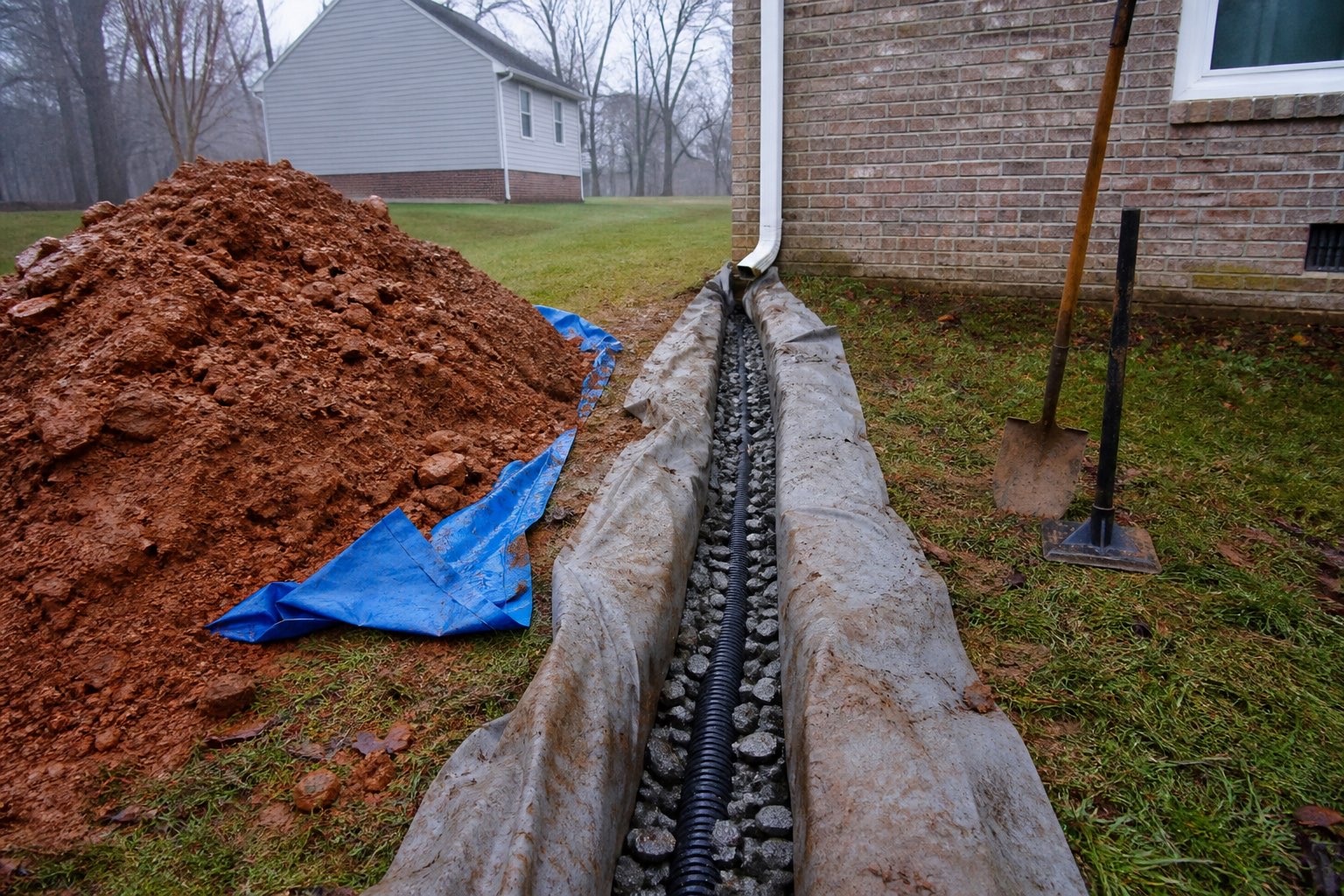
Shape the section, then line it. NRCS allows a triangular, parabolic or trapezoidal cross section for a lined waterway. The shaped channel in clay gets a layer of geotextile fabric pressed flat against the bottom and both banks, with the edges tucked under the turf. NRCS describes geotextile, where appropriate, as a separator that keeps soil particles from the subgrade from migrating through the lining. On red clay, our view is that this layer is what keeps the stone clean and sitting where it was placed. Filter fabric is already on Outdoor Custom Hardscapes' drainage materials list alongside #57 stone.
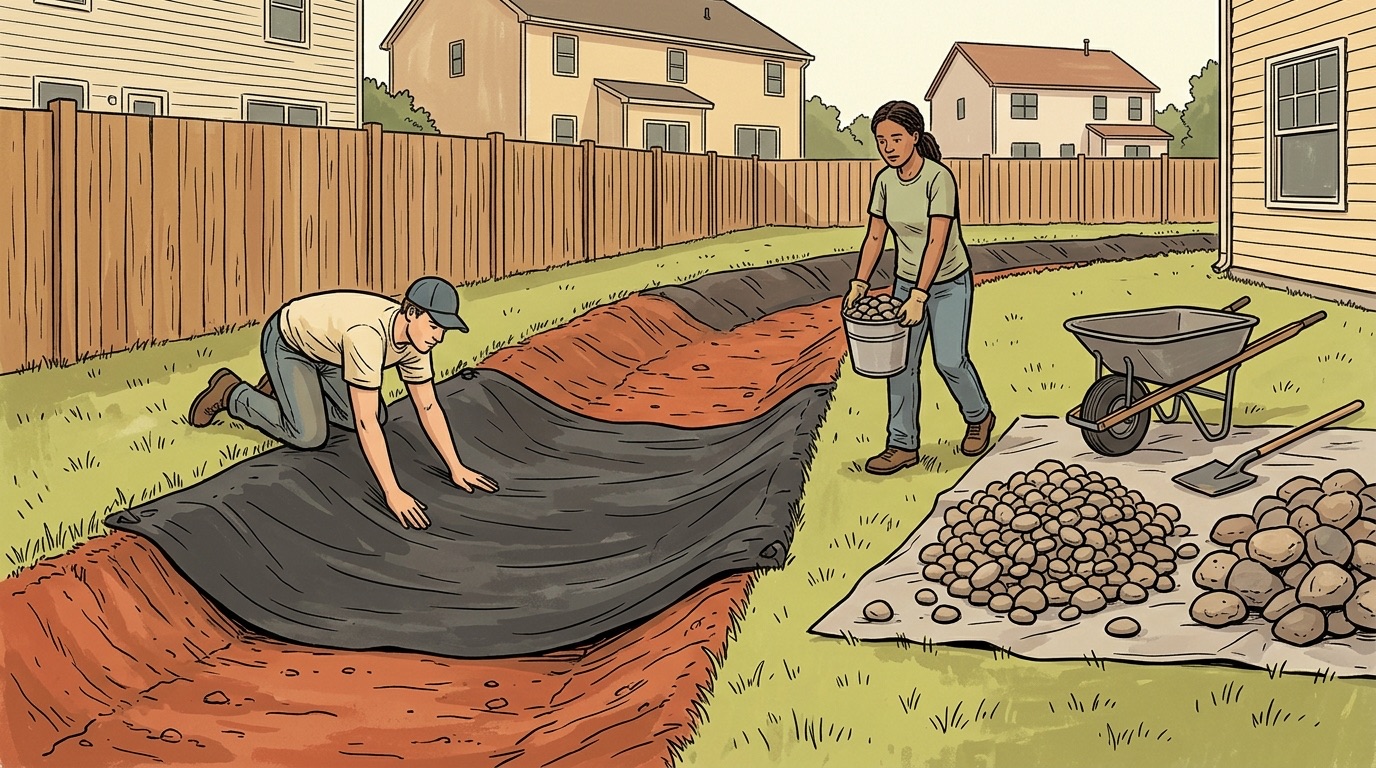
Size the stone to the water, then place it. The NRCS standard sizes rock for a lined channel from its design velocity using the National Engineering Handbook's stone sizing criteria, and it sets the minimum lining thickness at the largest stone size plus the filter or bedding. In plain terms: faster water needs heavier stone, and the lining has to be at least one big stone deep over the fabric. Decorative river rock alone may be too small for a steep run, which is where larger cobble and boulders earn their place in the channel rather than on its edges.
Plant the banks, not the channel. NRCS suggests incorporating trees, shrubs, forbs and grasses next to the lined portion, where they can improve appearance and habitat and reduce erosion potential, especially where the channel meets natural ground. It also says to keep the flow channel free from obstruction. The Davidson County garden followed the same order: rock first, then plants around it.
The outlet is where the design is won or lost
A creek bed that stops at the bottom of the yard has not solved anything. It has delivered faster, more concentrated water to whatever sits below it. The NRCS requirement quoted above is the standard to hold a design to: the end of the channel needs a stable outlet with enough capacity that it does not start its own erosion or flooding.
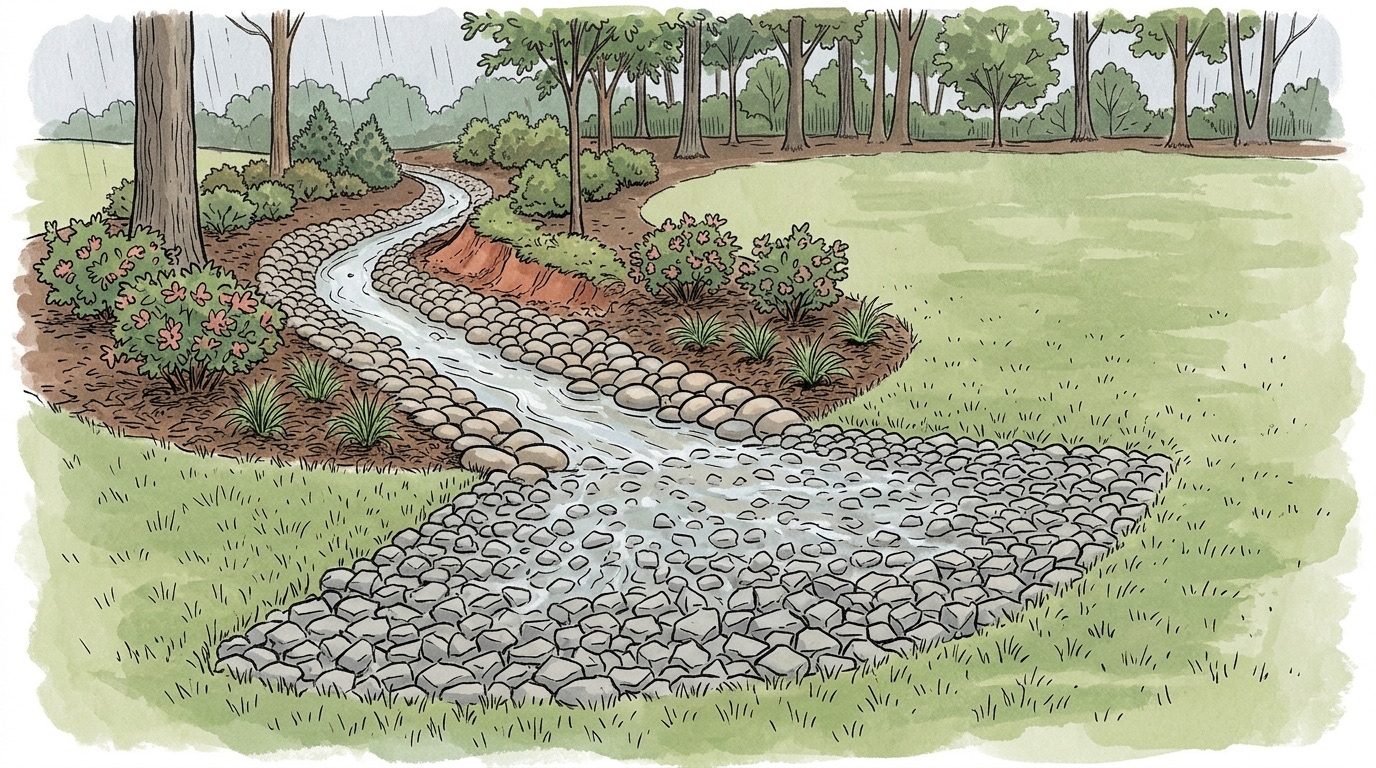
On a Charlotte-area lot the realistic outlets are few. The channel can end on a wide, flat stone apron that spreads the flow over a large grassed area you own. It can drop into a catch basin and a solid pipe that carries water to daylight lower on the property. On a flat lot with no lower point, it can end at a dry well sized to hold the water while it soaks away. What it should not do is point at a neighbor's yard.
Permits enter the picture here. Outdoor Custom Hardscapes' drainage FAQ says most drainage projects do not need permits, but discharge to a public right-of-way or stream can, and that the company checks before it starts. If the natural low point of your lot is the street, a storm inlet or a creek at the back line, that check belongs at the start of the design, not after the stone is placed.
When a French drain or a grass swale is the better call
If the look is the main reason for a dry creek bed, that is fine as long as the drainage half is real. When the water is below the surface, the fix is below the surface: our guide on when a Charlotte yard needs a French drain lays out the signs. When the lot is gentle and the flow is spread thin, a regraded lawn or grass swale does the same job with less stone to maintain.
A yard can need more than one of these. The Outdoor Custom Hardscapes drainage page describes designing grading, gutters, sub-surface drains and discharge together rather than as separate patches, and the soggy backyard write-up from Concord follows that kind of diagnosis end to end. A creek bed can be one piece of that system: the visible surface channel, with a buried line or a dry well doing the work where the surface cannot.
Keeping it working after the first big storm
Look at the channel after the first heavy rain, not after a drizzle. The CCAP manual's swale maintenance guidance carries over to a stone channel: if erosion occurs, reshape and stabilize the channel, and if substantial sediment builds up, remove it so flow is not blocked. It also notes that during extreme events, such as 25-year or 100-year storms, parts of a swale may be breached and should be repaired by the property owner.
Three things to check: stone that has shifted off the fabric and left it exposed, soil or mulch fanned out across the stone from the banks, and scour at the outlet apron. Each points to a specific repair, and each is easier to fix when you know what is in the ground. Outdoor Custom Hardscapes documents its drainage installs with photos and a diagram of what was buried, which is exactly the record you want when you are lifting stone two years later to find the fabric edge.
If water is cutting through your yard now, Outdoor Custom Hardscapes gives free on-site estimates across the Charlotte area and the Lake Norman towns. Call (980) 292-3663, and if it rains before the visit, take a short video of where the water goes. It answers design questions before anyone digs.
Frequently asked questions
Does a dry creek bed actually help with drainage?
Yes, when the problem is surface runoff. A dry creek bed is a stone-lined swale: it collects water that is already moving across the yard and carries it to an outlet without letting it cut a gully. NRCS lists safe conveyance of runoff and stabilizing gully erosion among the purposes of a lined waterway. It does not dry out saturated ground or fix a low spot with nowhere lower to drain; those need a French drain, a catch basin or a dry well.
Should I put landscape fabric under a dry creek bed?
On clay, we would. NRCS calls for geotextile, where appropriate, as a separator between a stone lining and the soil, to keep soil particles from migrating from the subgrade through the lining. The fabric should lie flat against the bottom and both banks of the channel.
How big should the rocks be in a dry creek bed?
There is no single size, because stone is sized to how fast the water runs. The NRCS standard sizes rock for a lined channel from its design velocity and sets the minimum lining thickness at the largest stone size plus the filter or bedding layer. A gentle channel can use river rock; a steep run needs heavier cobble and boulders in the flow path so a 10-year storm does not move them.
Dry creek bed or French drain: which do I need?
Watch the yard during rain. If water runs across the surface and follows a visible path, a dry creek bed fits. If the lawn stays soft for days with no visible flow, the water is in the soil and a French drain is the fix. Some yards need both, with a buried drain or dry well handling what the surface channel cannot.
Where should a dry creek bed drain to?
To a stable outlet on ground you control: a wide stone apron spreading flow over a large grassed area, a catch basin tied into a solid pipe that daylights lower on the property, or a dry well on a flat lot. NRCS requires lined waterways to have a stable outlet with enough capacity to prevent erosion and flooding. It should not discharge toward a neighbor's yard, and discharge to a public right-of-way or stream can need a permit.
Can a dry creek bed go on a steep slope?
It can, and steep slopes are where stone earns its place, because water runs faster than grass can hold. North Carolina's CCAP swale manual lists 4 ft/s as the maximum permissible velocity for grass and 6.5 ft/s for riprap. Steeper channels need larger stone, a thicker lining and banks no steeper than 2:1 under the NRCS standard. A long, steep channel draining a large area is a job for an engineered design.
Do I need a permit for a dry creek bed in the Charlotte area?
It depends on where the water goes. Outdoor Custom Hardscapes' drainage FAQ says most drainage projects do not need permits, while discharge to a public right-of-way or stream can, and the company checks before work starts. Call 811 before digging in any case.