French Drain Installation Cost in Charlotte, NC
French drain pricing in Charlotte turns on trench feet, depth, spoil volume and where the water can legally go. Here is what moves each one, and why.
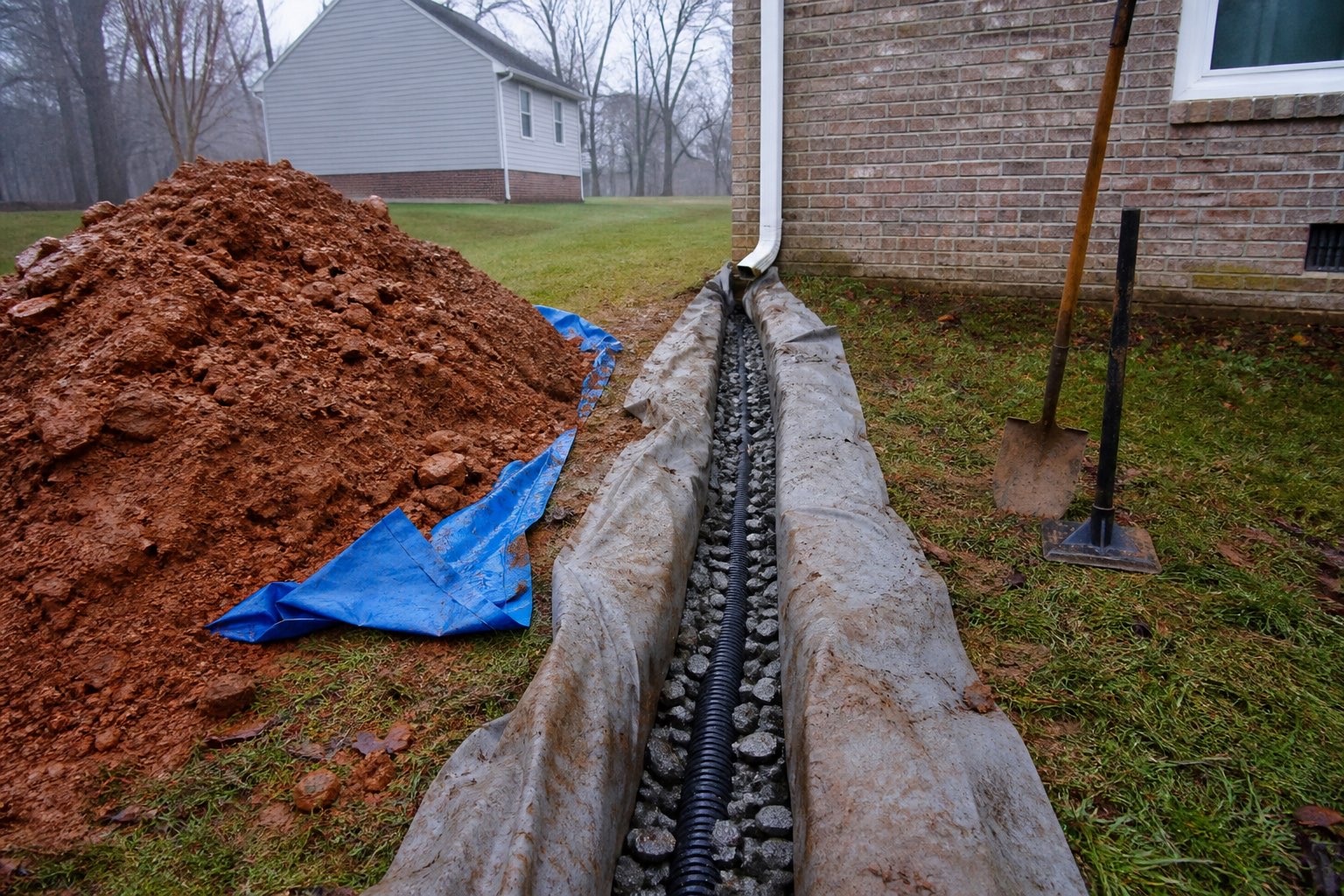
A French drain in Charlotte is priced by the foot, not by the job. Four measurements do most of the work: how many linear feet of trench the fix needs, how deep it has to run, how much wet clay comes out of the ground, and whether the property already has somewhere legal for the water to go. Two more, the footage that has to be dug by hand and putting the lawn back, decide whether the quote you are comparing is complete.
Outdoor Custom Hardscapes builds drainage across Charlotte, Huntersville, Davidson, Cornelius, Mooresville, Denver, Concord and the Lake Norman towns, and the reason two houses on the same street get very different quotes is almost always the fourth measurement, not the first. This is what each one does to the price.
Key takeaways
- Trench length is the headline number, but the discharge point is the one that moves the total most. A lot that falls away to the street costs far less to drain than a flat lot that needs a dry well or a pump.
- Depth is not a preference. It is set by what you are protecting, which is why a lawn drain and a footing drain are not the same job at different prices.
- Wet Piedmont clay does not rake back into the trench. It is spoil, it is heavy, and hauling it away is a real line item.
- The parts of a run that a machine cannot reach cost far more per foot than the open-yard footage does, because they are dug on a shovel.
- Outdoor Custom Hardscapes does not publish a flat per-foot rate. The estimate is free, on site, and itemized, so you can see which of these drivers is doing the damage on your lot.
What you are actually buying
A French drain is not a pipe. It is a trench filled with washed stone, wrapped in filter fabric, with a perforated pipe sitting at the bottom of the stone to carry away water that the stone has already collected. The stone does the gathering. The pipe does the moving. The fabric keeps the surrounding soil from silting up the stone, which is the failure mode that ends cheap installs early.
That structure is why the cost tracks volume rather than materials. Pipe is inexpensive. Moving several tons of saturated clay out of a yard, replacing it with clean washed stone, and putting the lawn back is not.
The measurements that set the number
Every honest drainage quote in this market is built from the same short list. The table below is job geometry, not a price list. Measure your own lot against these six lines and you will understand your quote before it arrives.
| Cost driver | Measured in | Why it moves the number |
|---|---|---|
| Trench length | linear feet | Labor, stone, pipe and fabric all scale with it |
| Trench depth | inches below grade | Depth multiplies spoil volume and hand-dig time |
| Spoil removed | cubic yards of wet clay | Saturated clay is hauled off, not spread |
| Distance to a legal outlet | feet from the trench end | The single largest swing factor on most lots |
| Footage a machine cannot reach | linear feet dug by hand | Hand digging runs a fraction of the daily footage |
| Lawn restoration | square feet of sod or seed | Putting the yard back is its own trade cost |
Run the spoil arithmetic once and the third row stops being abstract. A 60 foot trench, 10 inches wide and 18 inches deep, is 75 cubic feet of material, which is a shade under three cubic yards. That is a loaded trailer of wet clay, and it came out of a strip of lawn narrower than a sidewalk.
Where the water goes decides more than the trench does
This is the part homeowners almost never price in, and it is the most common reason two bids on the same house come back nowhere near each other.
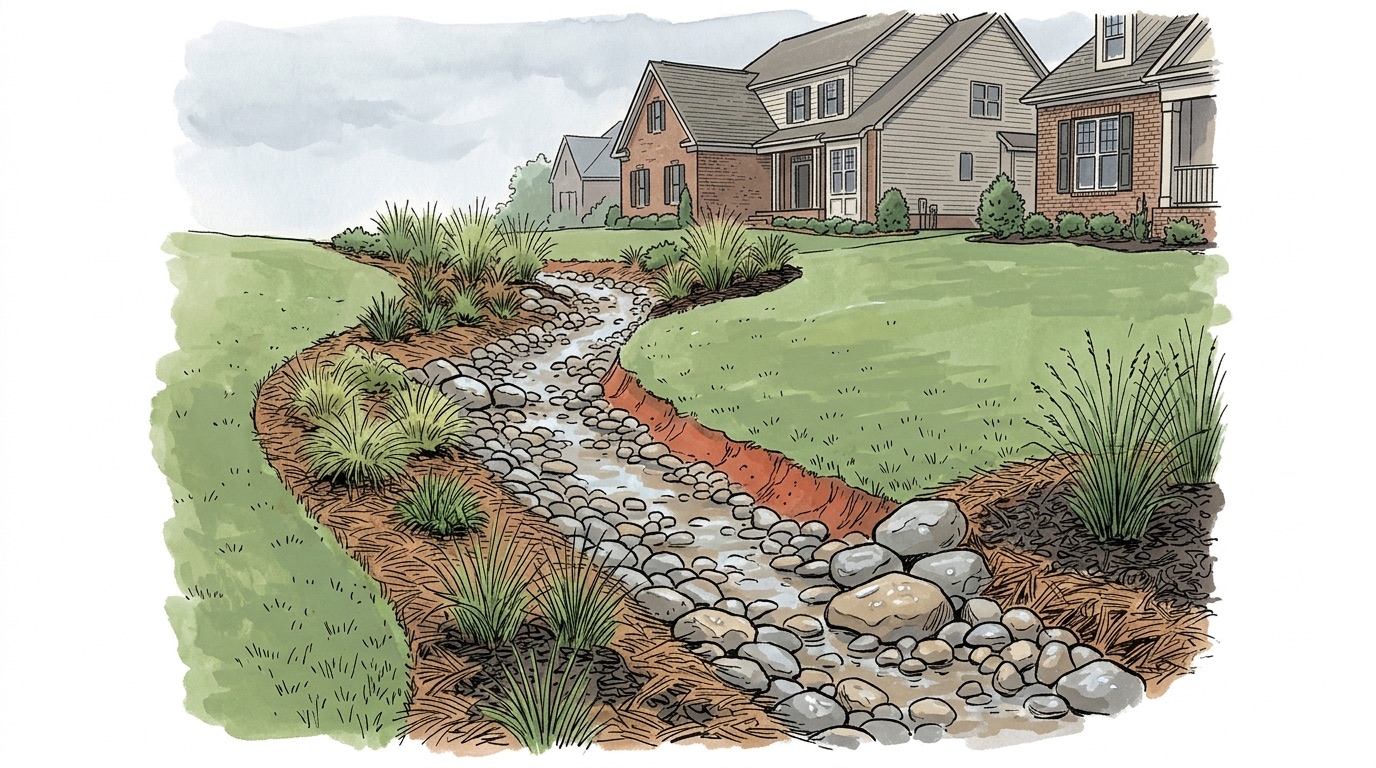
A drain has to end somewhere. If the lot falls away toward a street, a ditch or a low corner you own, the pipe daylights, the run ends, and the job is over. If the lot is flat, or if the only downhill direction is your neighbor's yard, the design changes completely. Now you need a dry well sized to hold the water until it can soak away, or a sump basin and a pump with its own power, or a much longer run to reach the one corner of the property that will accept it.
None of that shows up in a per-foot number, which is why a per-foot number quoted over the phone is close to meaningless here. It is also why the diagnosis has to come first.
We walk the property in the rain when we can, and trace water to its source.
Outdoor Custom Hardscapes, drainage service page
Why Charlotte lots behave the way they do
Charlotte sits in the Piedmont, and one of the soil series described there explains what a trench actually runs into. The USDA-NRCS Official Series Description for the Cecil series, revised in November 2025, describes a Piedmont uplands soil with a thin sandy loam surface layer, and directly beneath it a red clay horizon starting around 8 inches down and running 24 to 50 inches thick. The description of that clay is worth quoting for the words it chooses: firm, sticky, plastic.
That profile explains the two things homeowners here notice. Water disappears through the first few inches quickly, then stops. And a trench cut in July closes up like putty while a trench cut in February comes out in slabs. It is the same soil in both cases, and the crew's daily footage is not the same at all.
The volume of water is not extreme. NOAA's 1991 to 2020 U.S. Climate Normals put annual precipitation at Charlotte Douglas International Airport, station USW00013881, at 43.60 inches. That is an unremarkable number. What makes it a drainage problem is that a large share of it arrives in short summer storms and lands on a soil that will only accept it slowly, which is why yards here flood on the surface rather than saturating evenly.
Not every water problem is a French drain
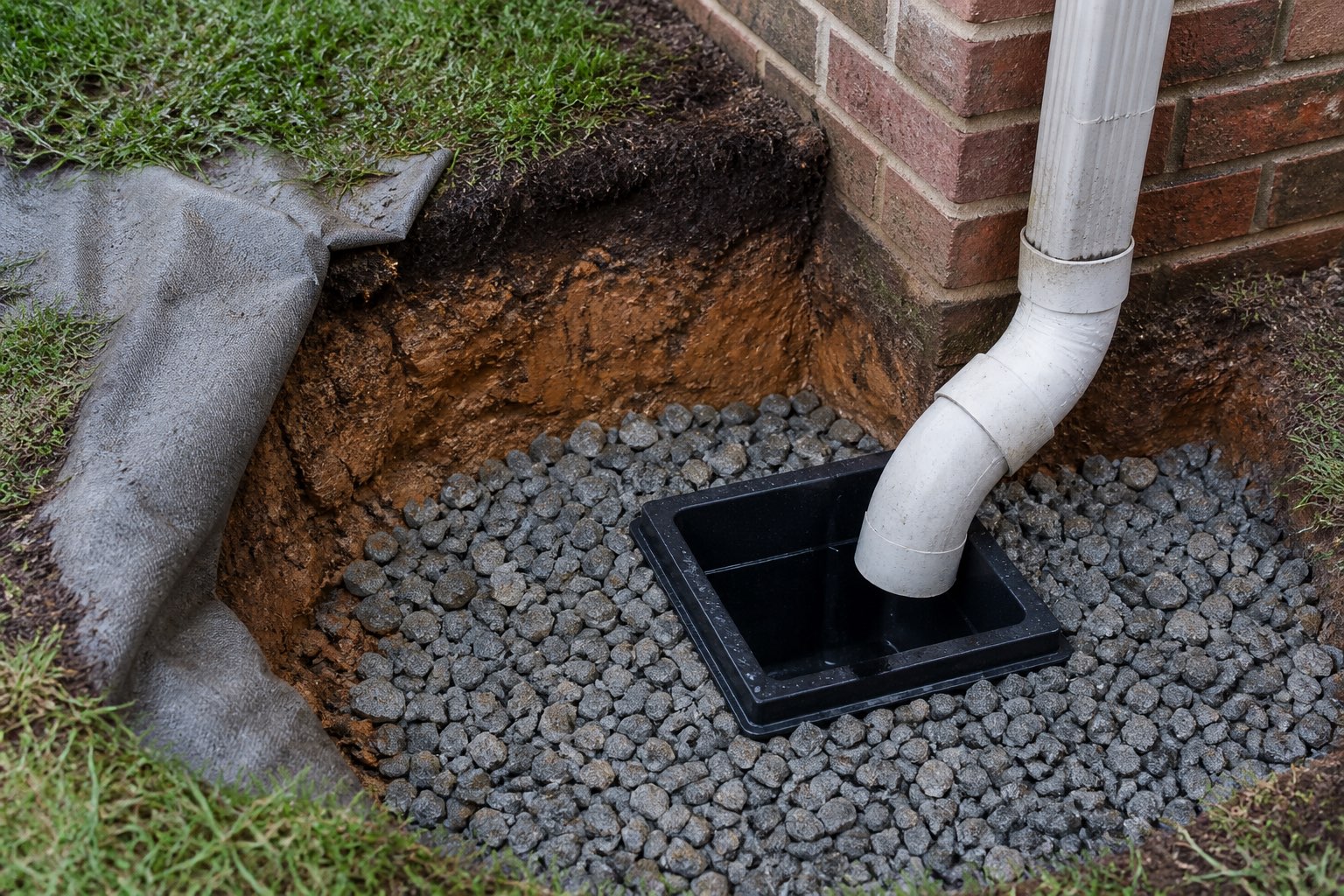
The cheapest drainage job is the one you do not do. A surprising share of the calls that come in as "I need a French drain" are solved by moving water that is already being collected. If every gutter on the house dumps at the foundation, burying those downspout lines and carrying them to daylight fixes the symptom for a fraction of the price, because a solid pipe carrying clean roof water can be shallow, narrow and fast to install.
A French drain earns its cost when the water is already in the ground, or already spread across the surface, and there is no single source to intercept. Outdoor Custom Hardscapes covers both approaches on the yard drainage and French drain service page, along with regrading, swales, channel drains, catch basins, dry wells and erosion control, and the diagnosis decides which one you are paying for. The companion guide on when a Charlotte yard actually needs a French drain walks through the signs that point each way, and the write-up on fixing a soggy backyard in Concord follows one of these diagnoses end to end.
The spec details that decide whether you pay twice
Three things separate a drain that keeps working from one that silts up quietly and stops.
The fabric wraps the stone, not the pipe. Sock-wrapped pipe is sold as a shortcut and it is a poor choice in clay, because the fines that clog it sit right against it with nowhere to go. Fabric lining the trench and folded over the top of the stone gives the silt a much larger surface to be stopped by.
Perforations face down. It looks wrong and it is correct. Water has to rise only to the bottom of the pipe to enter it, rather than filling the stone to pipe height first.
Solid pipe where the water is only travelling. Once the run leaves the collection zone and is simply carrying water to the outlet, perforated pipe just leaks it back into the ground you are trying to dry out. Outdoor Custom Hardscapes lists both perforated PVC and solid pipe among its drainage materials, alongside filter fabric, washed stone, catch basins and membrane, and the transition point between the two is a design decision, not a stocking accident.
None of these three cost much on the invoice. All three cost enormously if they are wrong, because the repair is the same excavation a second time.
Reading a drainage quote line by line
A quote that says "install French drain, $X" tells you nothing and protects nobody. An itemized quote should let you find, separately: the linear footage and depth of trench, the pipe type and diameter for each section, the stone spec, whether filter fabric is included, what the outlet is and where it goes, whether spoil haul-off is in or excluded, whether utility locates are handled, and what happens to the lawn afterwards.
Two of those hide the most money. Spoil haul-off is frequently excluded and then added, and lawn restoration is frequently left off entirely and discovered at the end. Ask about both before you compare two numbers, because a bid that includes them can look more expensive than one that does not while actually costing less.
Utility locates are free, and NC811 asks for no less than three full working days' notice before work starts, so they belong on the schedule rather than at the end of it. A contractor who does not mention them is telling you something about how they work.
Why there is no price on this page
Outdoor Custom Hardscapes publishes cost guidance for patios, driveways, outdoor kitchens and retaining walls, and does not publish a rate for drainage. That is not an oversight and it is not coyness. Drainage is the one service on the list where two jobs of identical size can differ enormously because of a single fact about the lot, and a headline per-foot figure would be wrong more often than right.
What is on offer instead is a free on-site estimate, itemized, from a crew that documents what goes in the ground with photographs and a diagram. On a service where the entire system disappears under the lawn on the last day, that documentation is the only thing that lets you check later that you got what you paid for. You can start that from the Charlotte service area page or by calling (980) 292-3663. If the drainage work is going in ahead of a patio, the sequencing matters and is covered on the patios and walkways page, because drainage that goes in after the pavers means lifting the pavers.
Frequently asked questions
How much does a French drain cost in Charlotte, NC?
There is no single figure, and any contractor who gives you one over the phone is guessing. The cost is driven by trench length in linear feet, depth in inches, the volume of clay that has to leave the property, and how far the water has to travel to reach a legal outlet. A short run on a lot that falls away to the street and a long run on a flat lot needing a dry well are the same service and very different jobs. Outdoor Custom Hardscapes quotes drainage line by line after an on-site visit, at no cost.
How deep should a French drain be in Charlotte clay?
Depth is set by what you are protecting, not by a standard. A drain intercepting surface water across a lawn sits shallow, because it only needs to be below the root zone and above the clay it is draining toward. A drain protecting a foundation or a crawl space has to sit below the level you are trying to keep dry, which pushes it far deeper and turns it into a different job with different excavation and different risk.
What is the difference between a French drain and a downspout drain?
A downspout drain is a solid, sealed pipe that carries clean roof water from a gutter to a discharge point. It collects nothing along the way, which is the entire idea. A French drain is a stone-filled trench with perforated pipe designed to collect water out of the surrounding ground along its whole length. If your problem is roof water dumping at the foundation, the downspout drain is the cheaper and better fix, and it is often mistaken for needing the more expensive one.
Where can a French drain legally discharge?
The outlet has to go somewhere that does not push your water onto adjoining property, and this constraint changes more designs than any other. On a lot with fall, that means daylighting to a low point you own or to a street or ditch that is permitted to receive it. On a flat lot it usually means holding the water on site in a dry well until it can soak away, or pumping it. Confirm the specifics for your address with Mecklenburg County or your municipality before work starts, because the answer is local and it decides the design.
Is a French drain cheaper than regrading the yard?
Often, yes, and often it is the wrong comparison. Regrading moves the surface so water runs where you want it, and where a lot has enough fall to work with, it can solve a problem permanently with no buried components to maintain. A French drain is what you install when regrading is not possible, not enough on its own, or would require moving more soil than the drain would. Good practice is to price the grading answer first and reach for the trench when it does not work.
How long does a French drain installation take?
Most residential runs are measured in days rather than weeks once the design is settled and utility locates are back, though the ground condition swings that hard. Clay that has been baked dry through a Carolina summer digs slowly, and clay that is saturated after a week of rain digs badly for different reasons. Add time for lawn restoration, and add considerably more if a dry well, a pump or a long tie-in to a distant outlet is part of the design.
Will a French drain fix water in my crawl space?
Sometimes, and it should not be the first thing you try. Crawl space water is most often surface water that was never controlled: gutters discharging at the wall, grade sloping back toward the house, or a downspout line that has failed underground. Those are cheaper to fix and they solve a real share of cases. If water is entering below grade after those are corrected, the answer is a drain at footing depth, which is a substantially larger excavation than a lawn drain and should be quoted as its own project.